How to Choose a Stainless Steel Mechanical Pressure Gauge?

Time:2026-10-20 Author:Charlotte
0%

Choosing a Stainless Steel Mechanical Pressure Gauge is not a cosmetic decision. It affects safety, maintenance, and measurement confidence. The wrong gauge may survive the first inspection, then fail beside a vibrating pump or corrosive process line.

Industry data supports careful selection. Grand View Research identifies oil and gas, chemicals, pharmaceuticals, and food processing as important pressure gauge applications. These sectors demand corrosion resistance, readable indication, and stable performance. MarketsandMarkets also reports continued growth in industrial pressure measurement, driven by process automation and stricter monitoring requirements. However, market reports often group different gauge technologies together. They should guide research, not replace engineering judgment.

Measurement quality matters. NIST Technical Note 1297 explains that reliable results require evaluating both random and systematic uncertainty. Lord Kelvin stated, “When you can measure what you are speaking about, and express it in numbers, you know something about it.” His principle remains relevant here. A gauge’s case material, wetted parts, accuracy class, pressure range, connection, and calibration history all deserve attention. A 0–100 bar gauge may look suitable, yet it can be poorly chosen for a 12 bar operating line. The pointer may barely move.

A practical selection process should examine media compatibility, temperature, pulsation, vibration, overpressure, and installation position. ASME B40.100 provides recognized guidance for pressure-gauge performance and testing. Still, no checklist is perfect. Real installations are untidy. Condensation, blocked impulse lines, and rushed maintenance can defeat an excellent specification. This guide explains how to choose a Stainless Steel Mechanical Pressure Gauge with evidence, field experience, and a healthy willingness to question assumptions.
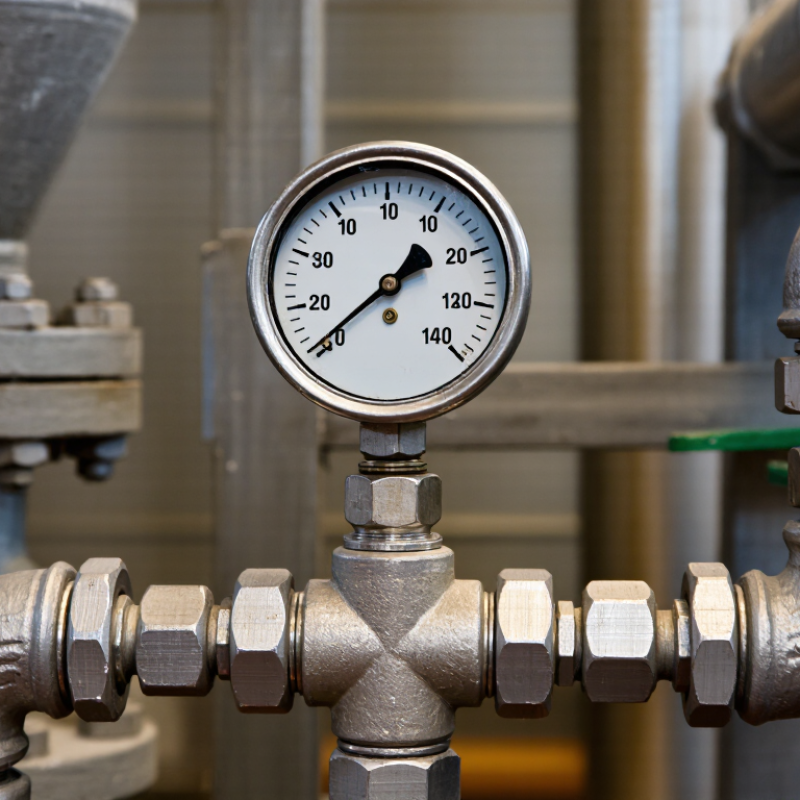
How to Choose a Stainless Steel Mechanical Pressure Gauge?

Define Pressure Range: Apply the 1.6× Full-Scale Selection Rule

Choosing a stainless steel mechanical pressure gauge starts with the pressure range, not the dial size. A practical rule is to select a full-scale range about 1.6 times the highest expected operating pressure. If a system normally reaches 100 psi, a 160 psi gauge is a sensible starting point.

This keeps normal readings near the middle of the dial, where accuracy is usually easier to interpret. It also leaves room for short pressure spikes. A gauge rated too close to the working pressure may sit near its limit, causing pointer fatigue or reduced accuracy. Avoid choosing an excessively wide range, though. A 300 psi gauge for a 40 psi process can make small changes difficult to see.

Look beyond the number.

Check whether the pressure is steady, pulsing, or affected by pump vibration. In field inspections, a 1.6× calculation can still fail when pressure surges are frequent. A liquid-filled case, snubber, or restrictor may help, but each choice can slow response. Confirm the process temperature, connection size, seal material, and wetted-part compatibility before ordering. Stainless steel resists many harsh environments, yet it is not automatically suitable for every fluid. I have seen selection mistakes caused by ignoring cleaning chemicals and temperature cycles. Pressure readings should also be compared with a calibrated reference during commissioning, because installation position and mechanical shock can introduce errors.

How to Choose a Stainless Steel Mechanical Pressure Gauge?

Define the pressure range using the 1.6× full-scale selection rule

For reliable operation, select a gauge whose full-scale range is at least 1.6 times the maximum expected operating pressure. The selected ranges shown above are rounded up to practical standard pressure ranges to keep normal operating pressure below the upper end of the dial.

Match Accuracy: Compare EN 837-1 Classes 0.1–4.0 and ASME Grades

How to Choose a Stainless Steel Mechanical Pressure Gauge?

Accuracy class should lead your selection. EN 837-1 lists classes from 0.1 to 4.0 percent of span. A Class 1.0 gauge may therefore show an error of up to 1 bar on a 100-bar range. That detail matters near alarm limits.

ASME B40.100-2022 uses accuracy grades, commonly expressed as a percentage of span. Grade A is typically 0.5 percent, while Grade B is commonly 1 percent. However, EN and ASME classifications are not automatically equivalent. Check the exact edition, temperature reference, and test conditions.

A gauge reading 40 bar on a 0–100 bar scale can hide more error than expected. Field technicians should also consider vibration, pulsation, overpressure, and process temperature.

Stainless steel improves resistance, but it does not remove measurement uncertainty. I sometimes prefer a less precise gauge with a better range match. That choice is not perfect, but it can improve readability.

Tips: Keep normal pressure near the middle of the dial. Select a range around 1.5 to 2 times operating pressure, where practical. Record the calibration date and tolerance beside the instrument. Compare the certificate with EN 837-1 or ASME B40.100-2022 requirements. Recheck after severe pulsation or accidental overpressure. Calibration records often reveal drift before operators notice it.

Select Materials: Choose 304 or 316 Stainless Steel for Media Compatibility

When choosing a stainless steel mechanical pressure gauge, match the wetted materials to the process medium. The wrong alloy may corrode quietly before the gauge shows an obvious failure. 304 stainless steel suits clean water, air, hydraulic oil, and many general industrial fluids. It offers dependable corrosion resistance and practical cost control.

316 stainless steel is a safer choice for saltwater, brine, coastal environments, and media containing chlorides. Its molybdenum content improves resistance to pitting and crevice corrosion. However, 316 is not automatically suitable for every chemical. Strong acids, high temperatures, or concentrated chlorides still require detailed compatibility checks.

Review the complete wetted path, including the socket, pressure element, and seals. The case material alone does not determine performance.

Tips: Ask for the medium’s concentration, temperature, and chloride level before selecting the alloy. Check whether cleaning agents contact the gauge during maintenance. A 304 gauge may perform well in a dry plant but fail near salt spray. I have seen specifications focus on pressure range while overlooking chemical exposure. That mistake is easy to repeat. When conditions are uncertain, consult current material-resistance data and confirm the selection with a qualified engineer. Allow some margin for process changes.

Verify Construction: Check Bourdon Tubes, IP65–IP67 Ratings, and Overpressure

A stainless steel mechanical pressure gauge should match the process, not just the display range. Check the Bourdon tube material against the measured medium. Copper-alloy tubes suit many general applications, while stainless steel tubes offer better resistance to corrosive fluids. However, stainless steel is not automatically suitable for every chemical. Compatibility tables and supplier data still matter.

Inspect the pressure range carefully. Experienced technicians often select a gauge whose normal reading stays near the middle of the scale. Readings near the maximum can accelerate tube fatigue.

Confirm the overpressure rating, too. A temporary pressure spike may permanently shift the pointer, even when the gauge still appears functional. That is an easy detail to underestimate. I have seen small installation errors create unreliable readings.

Tips: Look for an IP65, IP66, or IP67 rating when dust, washdown, or moisture is expected. IP65 protects against dust and water jets. IP66 handles stronger water jets, while IP67 allows temporary immersion under defined conditions. Verify the test conditions before relying on the rating. Also check the connection, dial visibility, vibration resistance, and whether a restrictor or snubber is needed. These small choices can prevent pointer flutter and improve field readings. Still, no gauge should replace regular calibration and visual inspection.

Confirm Installation: Evaluate Connection Size, Mounting Position, and Calibration Data

How to Choose a Stainless Steel Mechanical Pressure Gauge?

Confirm installation before comparing dial size or housing finish. Check the process connection against the instrument specification and piping drawing. Common connection sizes include 1/4, 3/8, and 1/2 inch, but thread standards can differ. NPT and BSP threads are not interchangeable. A forced fit may leak or damage the gauge.

Mounting position also affects readability and mechanical stress. Choose bottom, back, or panel mounting according to the actual pipe layout. Keep the dial visible without standing near hot or vibrating equipment. Use a siphon for steam service and a snubber for pulsating pressure, when required by the application. ASME B40.100 provides guidance for pressure gauge performance, accuracy, and installation practices. Its recommendations should be checked against the site’s engineering requirements. I have seen installation errors blamed on calibration. The real issue was often pipe strain.

Tips: Confirm the connection thread, pressure range, mounting direction, and media compatibility before ordering. Leave room for removal. It matters.

Review the calibration certificate before commissioning. Record the gauge serial number, test points, reference standard, and calibration date. NIST Technical Note 1297 recommends reporting measurement uncertainty with a coverage factor of k = 2, representing approximately 95% confidence. This detail supports traceability under ISO/IEC 17025 practices. Compare the gauge range with normal operating pressure. A gauge that runs near full scale may be difficult to read, while excessive range reduces resolution. Recheck the installation after vibration, maintenance, or a process change. Calibration data is useful only when the installed gauge matches the tested configuration.

FAQS

How should I choose the pressure range for a mechanical pressure gauge?

Select a full-scale range about 1.6 times the highest expected operating pressure.

Why is an oversized pressure range a problem?

An excessively wide range can make small pressure changes difficult to see.

What should I check when pressure pulses or equipment vibrates?

Check whether pressure is steady, pulsing, or affected by pump vibration.

Should I choose 304 or 316 stainless steel?

304 stainless steel suits clean water, air, hydraulic oil, and many general fluids.

Which materials need compatibility checking before ordering?

Review the complete wetted path, including the socket, pressure element, and seals.

How can I confirm the correct connection and mounting position?

Match the connection size and thread standard with the piping drawing.

When are a siphon, snubber, or restrictor useful?

Use a siphon for steam service when temperature protection is needed.

What calibration information should I review before commissioning?

Check the serial number, test points, reference standard, and calibration date.

Conclusion

Choosing the right Stainless Steel Mechanical Pressure Gauge requires evaluating operating conditions, measurement requirements, and installation details. Start by defining the expected pressure range and select a gauge with a full-scale value approximately 1.6 times the maximum normal pressure to improve readability and service life. Accuracy should match the application: compare EN 837-1 accuracy classes from 0.1 to 4.0 with applicable ASME grades, considering process control and safety needs.

Material selection is equally important. Stainless steel 304 suits many general applications, while 316 offers improved resistance to corrosive media. Verify the Bourdon tube and wetted components for media compatibility, and check whether the enclosure provides IP65 to IP67 protection against dust and moisture. The gauge should also tolerate possible overpressure. Finally, confirm the connection size, mounting position, and process access, and request calibration data or certificates when traceable measurement is required.


Charlotte

Charlotte

Charlotte is a seasoned marketing professional with a deep understanding of the company's portfolio and a passion for elevating its presence in the market. With a keen eye for detail and a commitment to excellence, she ensures that our professional blog is regularly updated with insightful articles......