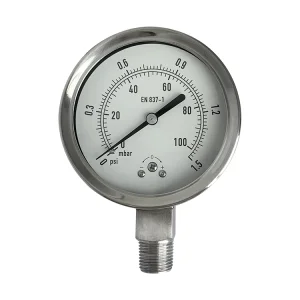
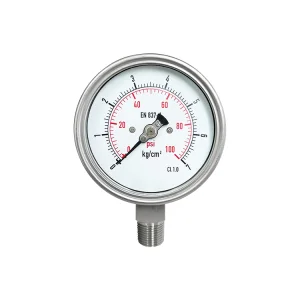
In contemporary industrial processing, accurate sensing of gaseous media at ultra-low static pressures—typically ranging from 0 to 6 mbar up to 0 to 600 mbar (0–60 kPa)—presents unique mechanical engineering challenges. Traditional Bourdon tube instruments fail to generate adequate elastic displacement when subjected to micro-pressures, leading to unacceptably high error margins and sticky indicator movement.
As a premier Low Pressure Capsule Pressure Gauge Manufacturer & Factory, Huzhou Accuracy Instrument Co., Ltd. addresses this physical limitation through advanced mechanical diaphragm box architecture. By joining two corrugated metallic diaphragms around their outer circumference, a capsule element is formed. When pressurized internally, the capsule expands proportionately on both sides, doubling the physical movement available to drive high-precision gear movements without incurring frictional hysteresis.
This whitepaper provides an exhaustive technical analysis of capsule pressure gauge mechanics, material metallurgy (including AISI 316L stainless steel vs. copper alloy capsule elements), atmospheric thermal drift compensation, zero-point external calibration mechanisms, and global compliance paradigms under EN 837-3 standards.
| Parameter | Technical Specification |
|---|---|
| Pressure Ranges | 0...6 mbar to 0...600 mbar (Vacuum & Compound available) |
| Accuracy Class | Class 1.6 standard (Class 1.0 available upon request) |
| Dial Diameters | 63mm (2.5"), 100mm (4"), 150mm (6") |
| Capsule Material | Beryllium Copper / Phosphor Bronze / Stainless Steel 316L |
| Process Connection | G 1/4", G 1/2", 1/4" NPT, 1/2" NPT (Bottom or Back Entry) |
| Zero Adjustment | Front-accessible micro-zero adjustment screw on dial face |
| Working Temperature | Ambient: -20°C to +60°C; Media: Max +100°C |
Huzhou Accuracy Instrument Co., Ltd. is professionally engaged in the development, sales, and service of industrial mechanical pressure gauges, bi-metal thermometers, SF6 manometers, micro-pressure capsule gauges, and advanced electronic pressure sensors. Our solutions are widely utilized across complex sectors including Mechanical Engineering, Chemical Processing, Food & Beverage Sanitary Systems, Pharmaceutical Facilities, and High-Technology Electric Appliances.
Established over two decades ago, our specialized pressure gauge manufacturing facility spans 3,000 square meters, fully equipped with automated laser-welding lines, high-precision laser calibration equipment, and environmental testing chambers. As a global OEM/ODM leader, we integrate mechanical engineering precision with material science to supply critical industries with zero-leak, long-lasting measurement hardware.
Dedicated exclusively to diaphragm metallurgy, linear movement kinematic optimizations, micro-pressure sensing technology, and global compliance engineering (ISO, API, EN standards).
Operating automated assembly lines, micro-soldering workstations, and computer-assisted calibration systems to guarantee uniform linearity and durability across all production batches.
Providing round-the-clock technical support, custom OEM design consultation, logistics tracking, and application engineering services across over 30 countries worldwide.
The core sensing element comprises two circular, corrugated metal diaphragms joined at their outer edges via high-frequency micro-TIG welding or precision brazing. When pressure enters the internal chamber of the capsule through the process connection, the opposing corrugated faces flex outwards in opposite directions.
This dual-action expansion amplifies the mechanical stroke by 200% compared to a single diaphragm system. The linear movement is transmitted via a linkage bar to a high-precision, low-friction movement gear cluster, turning the central pointer shaft across the calibrated dial scale.
Material choice dictates environmental immunity and mechanical life cycles:
All stainless steel variants feature IP65 ingress protection to prevent dust and humidity accumulation inside the window housing.
Because micro-pressure gauges sense small forces (as low as 0.001 bar), subtle changes in atmospheric pressure or installation angle can displace the zero reading.
Our engineered capsule gauges feature a dedicated external zero-adjustment screw conveniently located on the dial face or glass bezel. Technicians can instantly perform field re-zeroing without opening the instrument casing, maintaining measurement integrity without compromising factory seals.
Monitoring static duct pressure, air handling unit (AHU) flow balances, and filter differential pressure drops (HEPA filter clogging alerts) in commercial building automation systems.
Maintaining positive differential room pressures in cleanrooms, glove boxes, and bio-isolation units to prevent airborne contaminants from entering controlled environments.
Measuring low-pressure natural gas, bottled LPG, and combustion air supply in industrial furnaces, boilers, and commercial thermal processing equipment.
Providing micro-pressure regulation and safety monitoring for respiratory equipment, anesthetic gas delivery lines, and hospital vacuum systems.
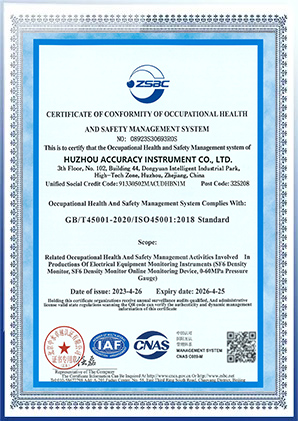
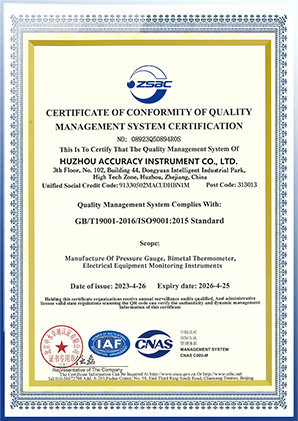
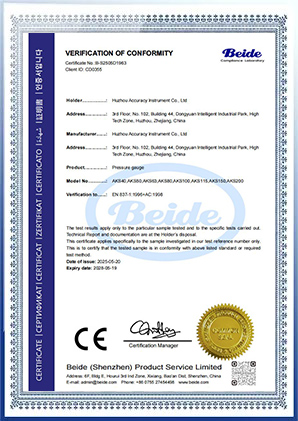
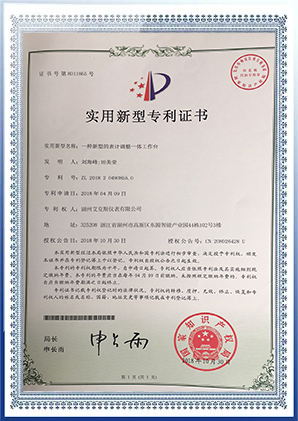
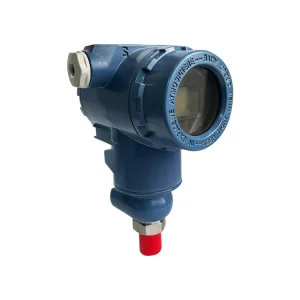
Integrating non-contact optical encoders within traditional mechanical capsule housings. This enables real-time local dial visualization while transmitting digital 4-20mA or RS-485 Modbus telemetry to central SCADA systems.
Developing specialized ultra-low-permeability stainless steel alloys (316L with electropolished inner surfaces) designed to monitor ultra-low hydrogen gas pressures without embrittlement risks.
Engineered internal travel-stop mechanisms that allow micro-pressure capsules (0-25 mbar) to withstand up to 1000% full scale overpressure spikes without permanent diaphragm deformation.
A Bourdon tube gauge utilizes a curved C-shaped tube that uncoils under internal pressure, which requires higher pressure levels (typically above 0.6 bar / 60 kPa) to achieve accurate displacement. In contrast, a Capsule pressure gauge uses two thin corrugated diaphragms welded around the perimeter. As low-pressure gas enters the internal chamber between the diaphragms, both sides flex outward, yielding high mechanical displacement at micro-pressures (down to 0–6 mbar).
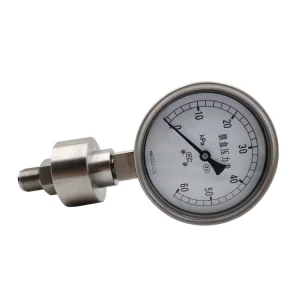
No. Standard capsule pressure gauges are designed exclusively for clean, dry gaseous media. Liquid media exerts hydro-static head pressure that can distort the delicate capsule diaphragms and prevent accurate zeroing. For low-pressure liquid applications, diaphragm seal pressure gauges or specialized liquid differential pressure transmitters should be specified.
Because capsule elements respond to extremely tiny mechanical forces, tilting the gauge can cause the weight of the capsule element and linkage gear to bias the pointer reading. It is recommended to calibrate and install capsule gauges strictly vertically. If horizontal or angled mounting is required, field zero adjustment must be performed via the external adjustment screw after final installation.
Copper alloy (brass/bronze) capsules are cost-effective for non-aggressive gases such as air, nitrogen, or clean natural gas in dry environments. Stainless steel (AISI 316L) capsules and housings are mandatory when measuring aggressive gases (e.g., biogas containing traces of H2S), in corrosive atmospheres (offshore/chemical plants), or in hygienic food and pharmaceutical facilities that undergo frequent washdowns.
Huzhou Accuracy Instrument Co., Ltd. incorporates internal travel-stop limiters into its capsule assembly architecture. These internal mechanical stops prevent the dual diaphragms from over-stretching beyond their yield point during transient pressure surges, protecting the mechanism up to 10 times full-scale pressure (depending on the exact range).
 Accuracy Instrument