Why Choose a Liquid Column Pressure Gauge? The answer begins with measurement clarity. A Liquid Column Pressure Gauge displays pressure through a visible fluid level, usually against a graduated scale. Operators can see the reading directly. No battery is required. No software update interrupts the process.
This simplicity remains valuable in laboratories, HVAC systems, cleanrooms, filtration units, and low-pressure gas lines. The ASHRAE Handbook identifies manometers as practical tools for measuring air and system pressure differences. The National Institute of Standards and Technology also emphasizes traceable pressure measurement through calibrated standards and documented uncertainty. Market research from MarketsandMarkets and Grand View Research shows continuing demand for pressure-sensing equipment across manufacturing, energy, healthcare, and building automation. Those reports focus on broader sensor markets, but they reveal an important trend: reliable pressure data supports safer and more efficient operations.
Lord Kelvin captured the measurement principle clearly: “When you can measure what you are speaking about, and express it in numbers, you know something about it.” His words fit this instrument remarkably well. A technician watching a meniscus rise two millimeters can detect a small pressure change without decoding a digital screen. That is the appeal.
Still, no gauge is perfect. Temperature changes can alter the liquid level. Installation errors can distort readings. Parallax may also mislead a hurried operator. These weaknesses deserve attention. Proper leveling, fluid selection, calibration, and routine inspection improve confidence. The best choice depends on pressure range, accuracy requirements, environment, and maintenance practice. Simple does not always mean effortless.
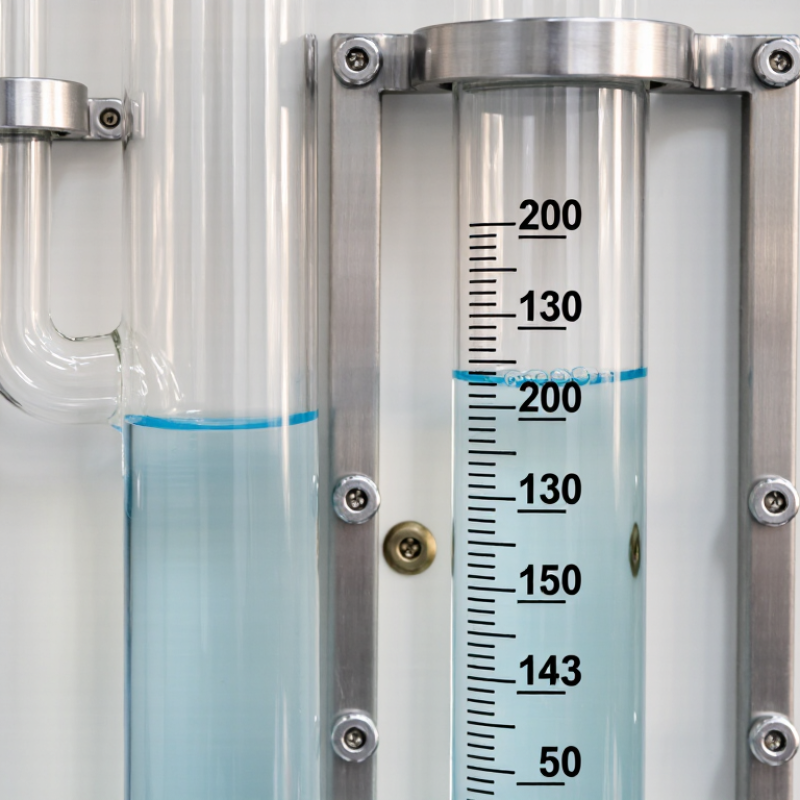
A liquid column pressure gauge measures pressure by balancing it against the weight of a liquid. The principle is simple. In a typical U-shaped tube, pressure pushes the liquid down on one side and up on the other. The height difference shows the pressure difference between two points. A denser liquid creates more pressure for the same column height, so the liquid choice affects measurement range and sensitivity.
In practical inspections, technicians read the meniscus at eye level and compare both sides with a marked scale. This small detail matters. Parallax, trapped air, vibration, or an uneven installation can change the reading. The gauge does not need gears, springs, or electrical power, which makes its operation easy to understand and verify. For low-pressure testing, laboratory work, ventilation systems, and calibration checks, this direct method remains useful.
However, a liquid column gauge is not perfect. Temperature can alter liquid density, while evaporation may affect long-term readings. Surface tension can also make the meniscus difficult to judge, especially in narrow tubes. I think its clear physical principle is a major strength, but its simplicity can invite careless handling. Operators should select a suitable liquid, keep the tube clean, and confirm the scale before trusting a small pressure difference.
A liquid column pressure gauge measures pressure through the height difference of a liquid. For water at standard gravity, pressure is calculated using P = ρgh, where ρ = 1,000 kg/m³ and g = 9.80665 m/s².
As the water column height increases, the measured pressure rises linearly. This simple relationship makes liquid column gauges useful for low-pressure measurements and visual reference.
A liquid column pressure gauge works through a simple balance between pressure and liquid height. In a U-tube manometer, applied pressure pushes the liquid down on one side and up on the other. The height difference, h, represents pressure through the relationship ΔP = ρgh. Here, ρ is liquid density and g is gravitational acceleration. No gears or electrical sensors are required. The reading appears directly on a calibrated scale.
That simplicity has practical value. A technician can see the meniscus move, check zero position, and notice unstable process pressure immediately. The instrument also offers a useful reference for calibration work. NIST Technical Note 1297 states that a coverage factor of k = 2 usually represents approximately 95% coverage for measurement uncertainty. However, the gauge is not perfect. Temperature changes alter liquid density. Dirty tubing can distort the meniscus. Parallax can shift a reading by several scale divisions. Small details matter.
ASME B40.100-2022 provides recognized guidance for pressure gauge performance, accuracy, and testing. Its principles support careful installation and routine verification. In field use, the gauge should remain vertical, free from vibration, and connected with tubing that avoids trapped air. Water suits many low-pressure applications, while denser fluids create greater pressure differences in shorter columns. That choice needs review. A narrow column improves sensitivity, but it may respond slowly and require more careful leveling.
Liquid column pressure gauges measure pressure through the height difference of a liquid. Their design is simple, visible, and easy to verify. Operators can watch the fluid level move inside a transparent tube. This makes small pressure changes easier to understand during equipment checks. The U-tube gauge is the most familiar type. It uses two connected arms and compares pressure on both sides. It works well for differential pressure, but reading the meniscus can require care.
A well-type gauge places one tube in a wider reservoir. The liquid movement in the narrow tube becomes more noticeable. This design saves space and supports quicker readings in routine testing. An inclined-tube gauge improves sensitivity by extending the liquid movement along a sloped scale. It suits low-pressure applications, air systems, and laboratory measurements. Some models use colored water, oil, or another calibrated liquid. The correct choice depends on density, temperature, compatibility, and expected pressure range.
Details matter here. A dirty tube can distort the reading. Temperature changes can also alter liquid volume and accuracy. Vertical alignment must be checked before trusting the scale. A common mistake is choosing the most sensitive gauge without considering vibration or installation limits. More sensitivity is not always better. Real equipment conditions may expose weaknesses that a catalog specification does not show.
Why Choose a Liquid Column Pressure Gauge? In many workshops, the answer begins with visibility. A liquid column moves directly as pressure changes. The reading is simple, physical, and easy to inspect from several steps away. This helps technicians notice unusual pressure before a machine develops a serious fault. These gauges also work without electrical power. That matters in remote rooms, dusty areas, or locations where wiring is inconvenient. With proper installation, the instrument can provide stable reference readings for routine checks. Its design has fewer moving parts than many mechanical alternatives. Fewer parts can mean fewer failure points, though it does not mean maintenance-free operation.
Experience shows that installation affects accuracy as much as the gauge itself. The device should stand level, with clean connections and suitable tubing. Vibration, temperature changes, and trapped air can distort the column. A qualified technician should confirm the scale range before use. Selecting a narrow range may improve readability, but excessive pressure can damage the tube. Periodic comparison with a calibrated reference is wise, especially in processes involving safety or quality. I have seen small reading errors grow when teams ignored condensation and loose fittings. That lesson is easy to overlook.
Tips: Keep the gauge vertical and protect it from impact. Mark the normal operating range clearly. Record readings during regular inspections. If the liquid level behaves strangely, stop guessing and investigate the connection, temperature, and pressure source. A liquid column gauge is straightforward, but straightforward tools still deserve disciplined care.
Selecting the right liquid column pressure gauge begins with the pressure range. Start with the expected operating pressure, not the system’s maximum rating. A gauge should normally operate near the middle of its scale. This improves readability and reduces measurement stress. For low pressures, choose a sensitive column with clear, evenly spaced graduations. Never choose a scale that is too broad.
Then check the liquid inside the gauge. Its density affects the reading and changes with temperature. Confirm that the liquid suits the surrounding temperature, process conditions, and required accuracy. A warm mechanical room can shift results. Use correction data when needed. Also inspect the wetted materials. They should resist corrosion and remain stable during long-term use. Connection size, mounting direction, and response time deserve attention too.
Readability matters in real work. Choose a scale that operators can read from their normal viewing distance. In field inspections, I often notice small bubbles or meniscus errors before noticing mechanical damage. The reference line must be consistent. Mounting position should remain level. Vibration can make the column move, so a protective enclosure may help. Outdoor installations need suitable visibility and environmental protection. Ask for a calibration record linked to a recognized reference. I have seen accurate gauges produce poor decisions because nobody checked zero before use. That mistake is easy to repeat. Recheck it.
| Selection Dimension | Available Options or Typical Values | Key Technical Consideration | Recommended Choice |
|---|---|---|---|
| Measurement Principle | Hydrostatic liquid-column measurement based on the difference in liquid levels. | The pressure difference is proportional to the liquid density and the height difference between the columns. | Choose a liquid column gauge when direct, simple, and highly visible pressure indication is required. |
| Pressure Type | Gauge pressure, differential pressure, or vacuum pressure. | Two connected pressure ports are generally used for differential measurement, while one port may be referenced to atmospheric pressure for gauge measurement. | Select a differential model for filter monitoring, airflow measurement, and pressure-drop measurement. |
| Measurement Range | Common low-pressure ranges include approximately 0–50 Pa to 0–2,000 Pa, depending on tube length, liquid density, and scale design. | A longer column can measure a larger pressure difference, but it requires more installation space. | Select the narrowest range that safely covers the normal operating pressure for better readability and resolution. |
| Scale Resolution | Typical scale increments range from about 1 Pa to 50 Pa in low-pressure applications. | Resolution depends on tube geometry, liquid meniscus visibility, scale spacing, and the operator’s viewing angle. | Use a fine-scale model when small pressure changes must be detected manually. |
| Accuracy | Typical practical accuracy is often around ±1% to ±3% of full scale, although the actual value depends on construction and operating conditions. | Accuracy can be affected by temperature, liquid density, vertical alignment, parallax, and reading the meniscus incorrectly. | Choose a calibrated model with a clearly marked meniscus reference when measurement records are important. |
| Working Liquid | Water, colored water, or a specialized low-vapor-pressure gauge liquid. | Liquid density directly affects the pressure-to-height relationship. Evaporation, freezing, contamination, and chemical compatibility must also be considered. | Use water for ordinary indoor conditions; use a compatible specialized liquid for low-temperature, high-visibility, or chemical-resistance requirements. |
| Temperature Conditions | Many standard installations operate near room temperature, commonly around 15–30°C. | Temperature changes can alter liquid density and may cause expansion, contraction, freezing, or evaporation. | For outdoor or temperature-variable installations, select a suitable working liquid and allow for temperature effects during calibration. |
| Installation Orientation | Vertical mounting on a stable, level surface is normally required. | An inclined or vibrating installation can produce reading errors and may change the apparent liquid level. | Choose a model with leveling features and install it vertically away from strong vibration. |
| Connection Configuration | Single pressure connection, dual pressure connections, hose barbs, threaded ports, or compression fittings. | The connection size must match the tubing and the pressure source. Leaks or blocked impulse lines can cause incorrect readings. | Select connections compatible with the existing tubing and use short, clean, properly supported pressure lines. |
| Response Behavior | Stable visual indication with a comparatively slow response when the liquid is damped by narrow tubes or flow restrictors. | Damping helps reduce fluctuations but can delay the indication during rapidly changing pressure conditions. | Use a damped liquid column for pulsating airflow; choose another sensing technology for fast transient measurements. |
| Operating Environment | Clean indoor air, ventilation systems, laboratories, cleanrooms, and low-pressure process monitoring. | Dust, corrosive gases, moisture, vibration, and mechanical impact may affect the liquid, tube, fittings, or readability. | Select protective covers, compatible materials, and contamination-resistant construction for demanding environments. |
| Typical Applications | Air-filter pressure drop, duct static pressure, fan and blower testing, cleanroom pressure difference, laboratory airflow, and room pressurization. | Liquid column gauges are especially useful where pressures are low and a direct visual indication is preferred. | Choose this gauge for routine low-pressure monitoring rather than high-pressure liquid or gas service. |
| Advantages | No external power, simple construction, direct visual reading, low maintenance, and good repeatability when properly installed. | The device provides a physical indication that can be easy to verify during inspections. | Choose it when simplicity, transparency, and low operating cost are more important than remote monitoring. |
| Limitations | Requires vertical installation, has a limited pressure range, may be affected by temperature, and usually does not provide an electrical output. | The working liquid can evaporate, freeze, become contaminated, or move during vibration and pressure surges. | Consider a digital or electronic pressure instrument when data logging, alarms, remote transmission, or wide-range measurement is required. |
| Maintenance Requirements | Check zero level, liquid condition, tube cleanliness, fittings, leaks, scale visibility, and mounting alignment. | Regular inspection helps identify evaporation, bubbles, contamination, blocked pressure lines, and meniscus-reading errors. | Establish an inspection and recalibration schedule based on application risk and measurement importance. |
| Final Selection Rule | Match the range, liquid, materials, connections, environmental rating, and accuracy to the application. | Do not select a gauge solely by nominal pressure range; installation conditions and measurement purpose are equally important. | Choose a liquid column pressure gauge when the application involves low pressure, stable conditions, clear visual reading, and no requirement for powered output. |
Note: The numerical ranges and accuracy values shown are typical engineering reference values, not universal specifications. Always confirm the final range, working-liquid properties, materials, temperature limits, and calibration requirements for the intended installation.
Pressure moves liquid through a U-shaped tube. The height difference shows pressure using ΔP = ρgh. No electricity is needed.
A larger height difference usually means higher pressure. Liquid density and gravity also affect the result. The scale displays the reading directly.
The moving liquid is easy to see from several steps away. It works without power and has few moving parts. Simple, but not foolproof.
Keep it vertical, level, and protected from vibration. Use clean tubing without trapped air. A loose connection can create a false reading.
Temperature changes can alter liquid density. That changes the pressure calculation slightly. Cold mornings and warm equipment rooms may not match.
Dirt can distort the meniscus, while parallax can shift the reading. Condensation, vibration, and unstable process pressure may also cause movement. Small details matter.
Water suits many low-pressure applications. Denser liquids create larger pressure differences in shorter columns. The choice needs review for temperature and sensitivity.
Check the zero position and record readings during inspections. Compare the gauge with a calibrated reference periodically. If the liquid behaves strangely, investigate instead of guessing.
A narrow column can make small pressure changes easier to see. However, it may respond slowly and require careful leveling. More sensitivity can bring more inconvenience.
A Liquid Column Pressure Gauge is a simple and reliable instrument used to measure pressure by observing the height difference of a liquid within a transparent tube. It works on the principle that pressure causes the liquid to move, creating a measurable level difference that corresponds to the applied pressure. Depending on the application, common types may include U-tube, inclined-tube, and well-type designs, each offering different ranges, readability, and installation benefits.
Choosing a Liquid Column Pressure Gauge can provide excellent visual clarity, dependable performance, and straightforward operation without complex mechanical components. It is particularly useful for low-pressure measurement, laboratory testing, air and gas systems, and educational demonstrations. When selecting the right model, consider the required pressure range, measurement fluid, tube design, scale resolution, mounting method, environmental conditions, and compatibility with the system. Proper selection helps ensure accurate readings, easy maintenance, and long-term service.
Accuracy Instrument