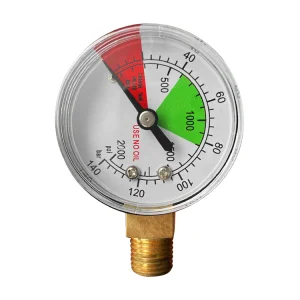
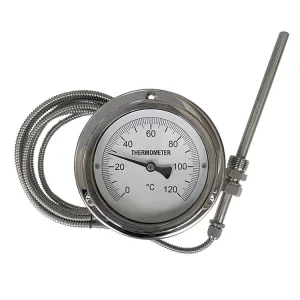
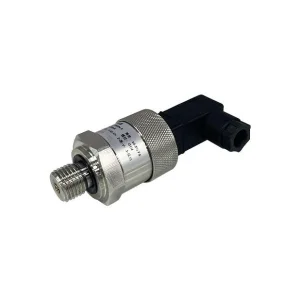
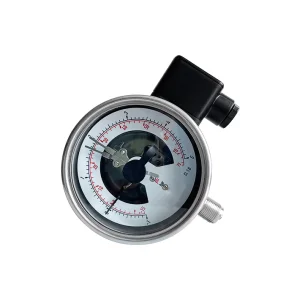
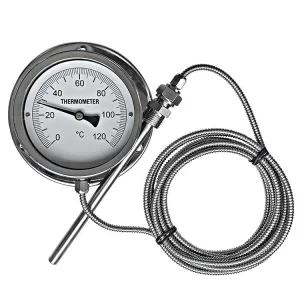
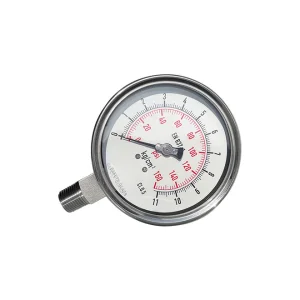
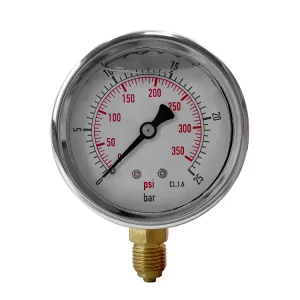
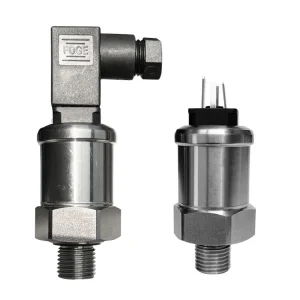
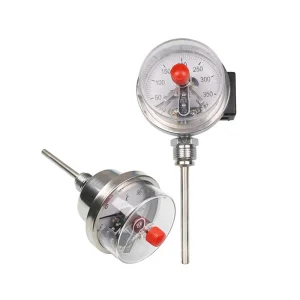
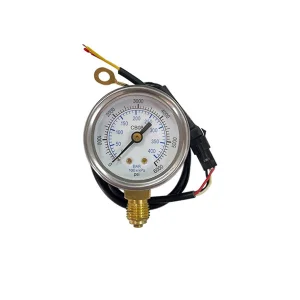
Explore our top-tier CE-compliant pressure gauges, transmitters, and capillary thermal instruments engineered for extreme industrial environments.
Technical Authority, Standardizations, and Sensor Integration in High-Pressure Gaseous Fuel Distribution
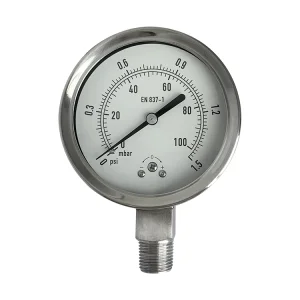
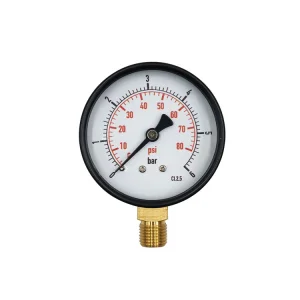
In the modern clean-energy ecosystem, Compressed Natural Gas (CNG) serves as a critical bridge fuel for heavy-duty transit, fleet logistics, and industrial power generation. Maintaining structural integrity and operational safety in high-pressure CNG environments requires metrological instrumentation capable of continuous, pulse-resistant performance. A CE Certified CNG Pressure Gauge Reading Unit is not merely a visual indicator; it represents a multi-tiered safety system combining Bourdon-tube mechanical dynamics with solid-state electrical signal transducers ( ratiometric 0.5V–4.5V, 5V, or 12V inputs).
As global safety directives evolve—most notably under the European Commission’s Pressure Equipment Directive (PED 2014/68/EU) and UNECE Regulation R110—manufacturers and global tier-1 suppliers must overcome core physical challenges: violent thermal expansion during rapid filling, continuous vehicle chassis vibration, and severe micro-leakage risks under 200 bar to 350 bar storage pressures.
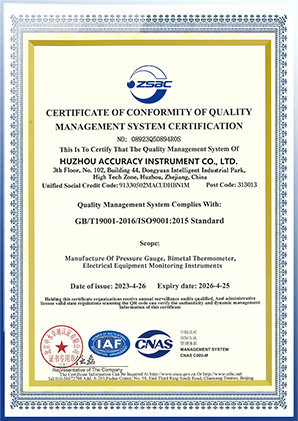
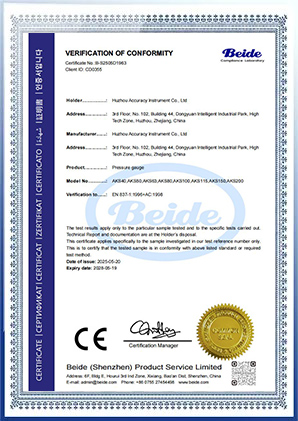
For international procurement engineers and fleet OEM integrators, verified certification acts as the primary risk mitigation threshold. The technical criteria for industrial CNG pressure gauges encompass several crucial international standards:
| Certification Standard | Target Market / Application | Critical Technical Requirements |
|---|---|---|
| CE (PED 2014/68/EU) | European Union & Global Exports | Full conformity to fluid group 1 (hazardous gases), burst pressure safety factors up to 4:1, and fatigue life testing (>100,000 pressure cycles). |
| ECE R110 | Automotive NGV Propulsion | Vibration resistance (up to 10G RMS), thermal operational range (-40°C to +120°C), thermal shock tolerance, and electromagnetic compatibility (EMC). |
| ISO 15500-8 | CNG Fuel System Components | Material compatibility (preventing Hydrogen Embrittlement and stress corrosion in brass or 316L SS), burst pressure safety margins, helium leak detection (< 10⁻⁵ mbar·l/s). |
| ATEX / IECEx | Hazardous Fuel Stations | Intrinsically safe electrical circuits for integrated Hall-effect or optical pressure-reading electronic transducers in Zone 1 / Zone 2 environments. |
Integrating mechanical visual indicators with electronic telematics requires robust material selection and signal calibration logic. The detailed architecture of our CE-certified CNG gauges includes:
Utilizing high-elasticity OT58 Brass or 316L Stainless Steel C-tubes and helical coils processed via automatic inert gas laser welding. Designed to withstand cyclic pressures up to 400 bar without mechanical zero-drift or elastic fatigue hysteresis.
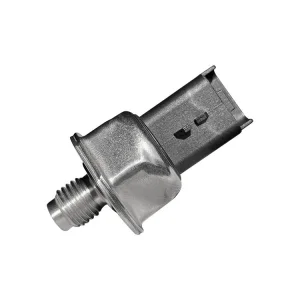
Instead of traditional mechanical potentiometers that suffer from friction wear, our CNG reading units feature non-contact Hall-effect sensors. The movement of an internal magnetic field converts physical pointer deflection into precise 0.5V to 4.5V ratiometric voltage signals for direct connection to vehicle ECUs or telemetry nodes.
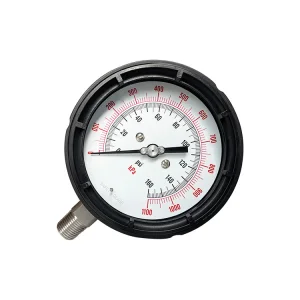
Engineered with IP65/IP67 ingress-protected cases filled with specialized silicone fluid or dampening gears. Eliminates pointer flutter caused by engine harmonics, high-frequency gas turbulence, and abrupt pressure spikes during rapid filling operations.
Huzhou Accuracy Instrument Co., Ltd. is professionally engaged in the development, manufacture, sales, and service of industrial mechanical pressure gauges, bi-metal thermometers, SF6 manometers, pressure transmitters, and high-precision CNG pressure gauge reading assemblies.
Established over two decades ago, our advanced pressure gauge manufacturing facility spans 3,000 square meters, equipped with automated production lines, laser welding cells, and rigorous digital quality control systems. We integrate innovation with precision engineering to deliver reliable measurement solutions for global tier-1 automotive and industrial clients.
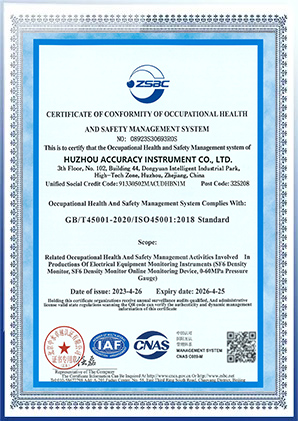
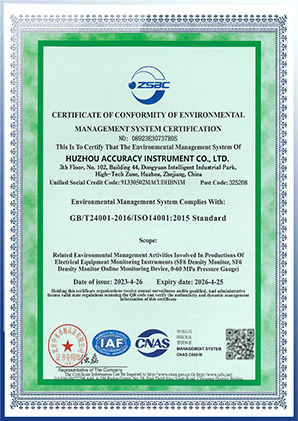
Adhering strictly to ISO 9001:2008 and ISO 17025 laboratory guidelines. Every CNG gauge undergoes 100% full-scale pressure testing and environmental simulation.
Precision CNG reading gauges operate across diverse global infrastructure networks. Below is how our engineering designs solve real-world industry demands:
In CNG-fueled passenger vehicles, city buses, and heavy-duty trucks, the gauge is installed directly on the high-pressure regulator or cylinder valve. It delivers real-time dual-output: a mechanical dial reading for maintenance technicians and an analog voltage output to dashboard fuel indicators and engine control units (ECUs).
Refueling dispensers subject gauges to severe pressure cycling from 0 to 250 bar within seconds. Our shatter-proof glass, liquid-filled stainless steel gauges prevent needle oscillation, protecting internal gear teeth and providing gas station operators with error-free visual verification.
Intermodal CNG tube trailers transporting natural gas at 200–300 bar across vast distances face constant road vibration and extreme ambient temperature fluctuations. Specialized capillary thermal gauges and IP67 sealed pressure reading units safeguard gas transport efficiency.
As industrial automation transitions towards Industry 4.0 and alternative zero-emission fuels, our R&D team is driving innovation along four primary technical pathways:
| Development Milestone | Current Generation Baseline | Next-Generation R&D Target | Industrial Value Proposition |
|---|---|---|---|
| Hydrogen (HCNG) Blend Compatibility | Standard OT58 Brass / 304 SS Construction | Specialized 316L SS & Hastelloy C-276 Alloys | Eliminates hydrogen embrittlement in blended natural gas networks (up to 20% H₂ concentration). |
| Digital Wireless Telemetry | Hardwired 5V/12V Analog Output (0.5V-4.5V) | Low-Power LoRaWAN & NB-IoT Wireless Nodes | Enables remote real-time cylinder monitoring for virtual pipeline fleets without complex wiring harnesses. |
| Smart Micro-Fused Sensors | Mechanical Bourdon with Hall Sensor | Glass Micro-Fused Silicon MEMS Transducers | Higher burst tolerance (>500 bar), sub-millisecond response times, and extended operating thermal limits. |
| Self-Diagnostic Nodes | Manual Zero-Point Mechanical Adjustment | Integrated Firmware Temperature Compensation | Automatic drift correction eliminates routine zero-calibration maintenance in harsh extreme climates. |
Explore additional certified sensors, contact gauges, and thermal monitoring devices from Huzhou Accuracy Instrument.
 Accuracy Instrument