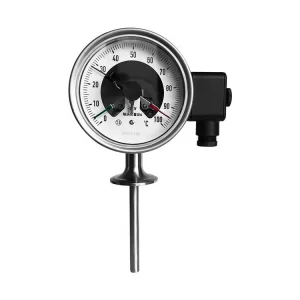
Direct from Factory Direct Lines — Engineered to ASME B40.200 and EN 13190 Standards
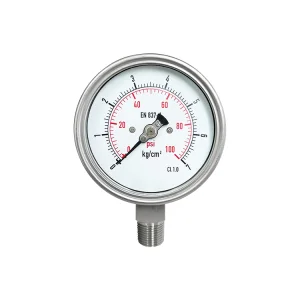
In modern industrial process engineering, mechanical temperature measurement remains the backbone of operational safety, asset monitoring, and quality control. At the heart of this mechanical reliability is the Bimetal Dial Thermometer—a self-sustaining, non-electric instrument that converts thermal energy into mechanical movement with exceptional precision. But to fully understand how these rugged instruments operate under aggressive field conditions, OEM buyers and process engineers must analyze the underlying metallurgical physics and mechanical transmission systems.
The core operating mechanism of a bimetal dial thermometer relies on a simple physical law: different metals expand at different rates when subjected to thermal energy changes. The active sensing element is a composite strip formed by permanently bonding (via cold welding, hot rolling, or explosive cladding) two distinct metallic alloys possessing vastly different Coefficients of Thermal Expansion ($\alpha$).
When the bonded bimetallic strip undergoes a temperature shift, the high-expansion alloy expands (or contracts) much faster than the low-expansion Invar layer. Because both metals are molecularly joined along their entire interface, this physical imbalance forces the flat strip to bend or curve toward the side with the lower coefficient of expansion. The mathematical radius of curvature ($R$) resulting from a temperature change ($\Delta T$) is governed by the classic Timoshenko Bimetal Equation:
$$\frac{1}{R} = \frac{6 (\alpha_1 - \alpha_2) \Delta T (1 + m)^2}{t \left( 3(1+m)^2 + (1+mn)\left(m^2 + \frac{1}{mn}\right) \right)}$$
Where $t$ represents total strip thickness, $m$ is the thickness ratio of the two metals, and $n$ is the ratio of their Elastic Moduli. This mathematical relationship ensures that mechanical deflection is strictly proportional to temperature changes.A straight bimetallic strip produces small physical displacements that are difficult to measure accurately on a dial. To fit a long bimetal strip into a compact industrial probe (stem), instrument manufacturers wind the strip into tight continuous geometries:
| Coil Geometry | Structural Mechanics | Primary Industrial Application | Performance Advantages |
|---|---|---|---|
| Helical Bimetal Coil | Wound like a high-density spring inside a narrow cylindrical stem tube. Expands axially and rotates torsionally along the central axis. | Standard Rigid Stem Dial Thermometers (Back, Bottom, Every-Angle Mounts). | Minimal space footprint, high torque output, direct axial drive eliminating complex transmission gears. |
| Spiral Bimetal Coil | Wound flat in a single plane like a watch mainspring. Deflects outward radially upon heating. | Surface-mount thermometers, thin-profile dial gauges, HVAC duct monitors. | Uniform planar expansion, optimal for flat contact surfaces, simple visual integration. |
In high-grade industrial helical bimetal thermometers, one end of the helical coil is anchored securely at the tip of the protective stainless steel stem. The other end is connected directly to a lightweight, rigid inner pointer shaft running up through the stem into the dial housing. As temperature fluctuates, the helical coil winds or unwinds, rotating the central shaft. This rotational force drives the pointer smoothly across a $270^\circ$ to $300^\circ$ calibrated linear dial arc without requiring any internal multiplying gears or liquid fills.
Eliminating multiplying gears significantly reduces mechanical friction, wear, and back-lash error, allowing OEM bimetal thermometers to achieve standard accuracy classes of Class 1.0 ($\pm 1.0\%$ of full scale span) under EN 13190 guidelines.
Established over two decades ago, Huzhou Accuracy Instrument Co., Ltd. is a premier global manufacturer specializing in the development, OEM customization, and continuous mass production of industrial mechanical pressure gauges, bimetal thermometers, SF6 gas density monitors, and intelligent pressure sensors.
Spanning an advanced 3,000 square meter manufacturing facility, our factory integrates automated assembly lines, high-precision laser welding stations, and zero-leak pressure testing chambers. We service Tier-1 clients across Mechanical Engineering, Chemical Processing, Food & Beverage, Medical Systems, and Power Utilities.
ISO 9001:2008 & ISO 17025 Certified Production | 100% Pressure Cycle Testing | 1-Year Comprehensive Warranty
Our R&D department focuses on advanced bi-metallic alloy metallurgy, anti-vibration silicon damping fluids, smart electronic switch integration, and custom stem fitting designs aligned with international standards (ASME B40.200, EN 13190, API).
Equipped with micro-laser welding setups and automated calibration rigs, our workforce executes high-volume manufacturing while guaranteeing zero-leak seals and exact radial/back stem orientation.
15 international sales and field application engineers offer 24/7 technical support, helping EPC contractors and original equipment manufacturers select proper stem lengths, thermowell materials, and dial scale customized branding.
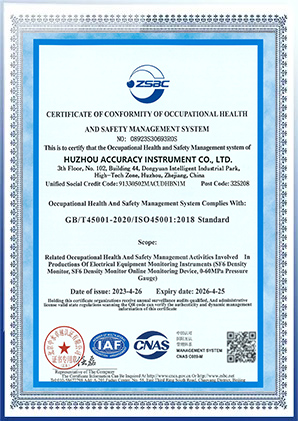
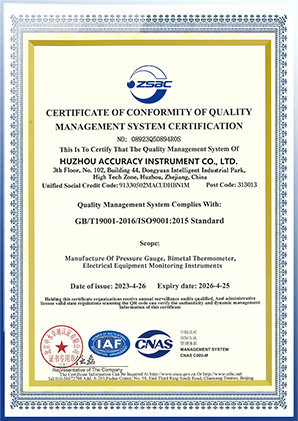
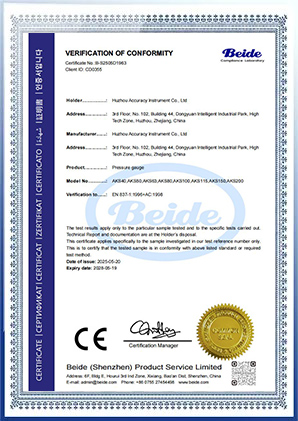
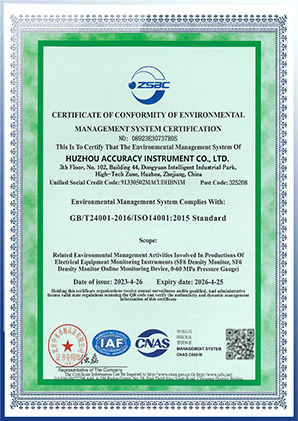
Strict quality assurance certified under ISO9001:2008, CE, SGS, and regional safety directives.
Tailored Mechanical Temperature Instruments Built for Extreme Environments
Exposed to severe hydrogen sulfide ($H_2S$) and marine atmospheric corrosion, our OEM bimetal thermometers utilize 316L Stainless Steel stems and cases paired with heavy-duty thermowells (Tapered, Stepped, or Straight) to withstand pressures up to 100 bar and thermal loads over $+600^\circ\text{C}$.
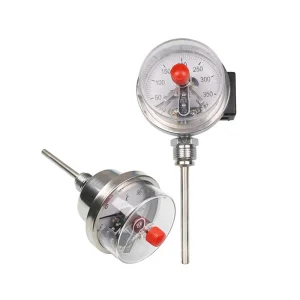
High-voltage power transformers demand automated temperature alarms. We integrate magnetic snap-action electric switch contacts (SPDT/DPDT) directly into $100\text{mm}$ bimetal gauge dials. As oil temperatures rise, internal contacts trigger cooling fans or immediate safety trip-switches.
For clean-in-place (CIP) and sterilize-in-place (SIP) compliance, our factory manufactures tri-clamp sanitary connection bimetal thermometers with Ra < 0.4 µm polished surfaces, eliminating bacteria traps and satisfying 3-A and FDA standards.
High continuous equipment vibration can damage mechanical linkage. Huzhou Accuracy supplies liquid-filled (silicone oil) dampening cases, stabilizing the dial pointer and eliminating internal mechanical wear caused by structural resonance.
As chemical plants and energy utilities shift toward Industry 4.0 digitisation, the traditional mechanical bimetal dial thermometer is evolving. Modern procurement teams no longer look for simple stand-alone visual gauges; they seek Hybrid Smart Sensing Platforms that combine localized zero-power mechanical indication with remote digital telemetry.
Integrating a micro-thin RTD (Pt100) or Thermocouple wire directly inside the bimetal probe stem. This allows local mechanical dial reading during power outages while simultaneously feeding a 4-20mA HART digital signal to centralized Distributed Control Systems (DCS).
Developing specialized bi-metallic alloy formulations capable of linear expansion at extreme sub-zero temperatures (down to $-196^\circ\text{C}$ for Liquid Natural Gas / LNG processing), eliminating non-linear hysteresis errors.
Transitioning all case-to-stem joint connections to automated orbital laser seam welding, reaching IP68 ingress protection and guaranteeing 100% moisture-free internal dial chambers.
Expert Engineering Solutions for OEM Buyers & Process Engineers
Proven Reliability Engineered Across 20 Years of Factory Precision
 Accuracy Instrument