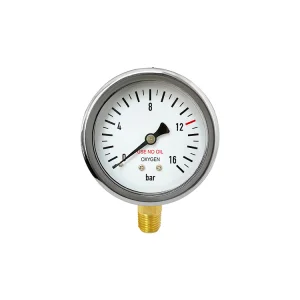
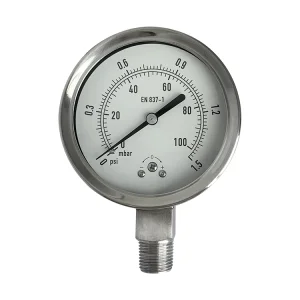
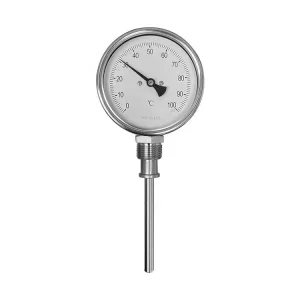
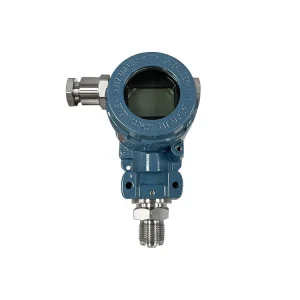
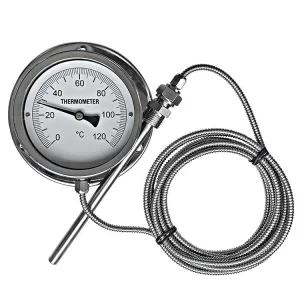
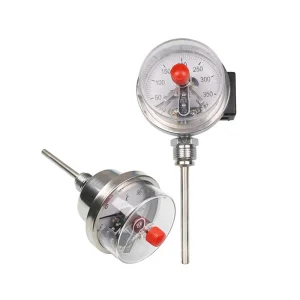
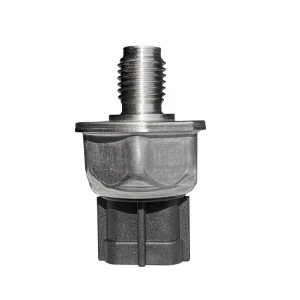
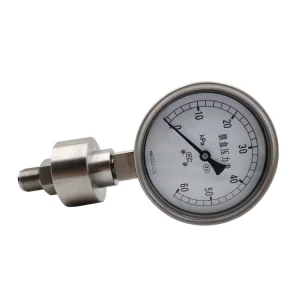
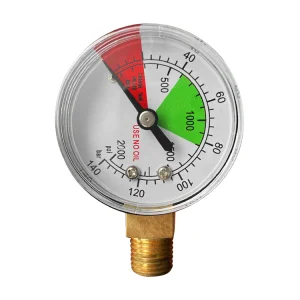
In modern industrial processing, mechanical thermal control remains the cornerstone of operational safety, asset integrity, and thermodynamic efficiency. As a premier China Contact Thermometers Manufacturer, Huzhou Accuracy Instrument Co., Ltd. bridges physical thermal dynamics with precision manufacturing.
Contact thermometers—encompassing bimetallic strip indicators, expansion capillary systems, and integrated electrical switch contact gauges—measure temperature through direct kinetic energy transfer from the process media to the sensor stem. Unlike non-contact infrared sensors which are prone to emissivity errors and optical obstructions, contact instruments provide direct, highly reproducible, and continuous thermodynamic feedback under extreme vibration, corrosive atmospheric conditions, and high electromagnetic interference (EMI).
Our 3,000 m² state-of-the-art facility integrates automated metallic coil winding, helium mass spectrometer leak detection, micro-laser welding, and automated thermal bath calibration to manufacture over 2 million units annually.
Modern process plants demand thermal monitoring systems engineered specifically for harsh operating micro-environments. Below is an engineering analysis of how contact thermometers address specific macro-industrial challenges:
Direct stem contact thermometry utilizes heavy-wall AISI 316L or Hastelloy C-276 thermowells to withstand high velocity, sulfur-rich, and aggressive hydrocarbon streams up to 600°C without mechanical shear failure.
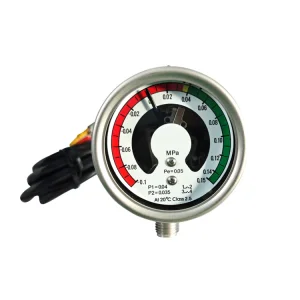
Specialized SF6 gas density monitors combine contact bimetallic thermal compensation with Bourdon pressure mechanisms, assuring precise gas density calculation independent of ambient temperature spikes in high-voltage switchgear.
Sanitary tri-clamp contact sensors feature mirror-polished stems (Ra < 0.4 µm) to eliminate micro-bacterial crevices, enduring CIP (Clean-in-Place) and SIP (Steam-in-Place) thermal cycling up to 150°C.
As OEM buyers and EPC contractors evaluate thermal measurement suppliers, technical metrics dictate longevity, recalibration intervals, and system integration. Huzhou Accuracy Instrument provides comprehensive standardized parameters across our key contact thermometer lines:
| Instrument Category | Operating Range (°C) | Accuracy Class | Sensor Element Tech | Ingress Protection | Primary Industrial Application |
|---|---|---|---|---|---|
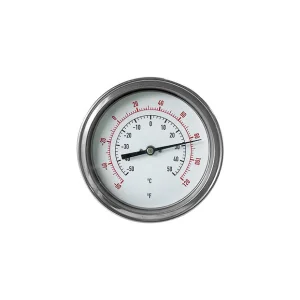
| Bimetallic Thermometers (Direct Mount) | -50°C to +600°C | Class 1.0 / Class 1.5 (±1.0% FS) | Helical / Spiral Bi-metal Strip | IP65 / IP67 (Silicone Filled) | Pipelines, Boilers, Diesel Engines |
| Capillary Remote Reading Thermometers | -40°C to +400°C | Class 1.5 / Class 2.0 | Liquid/Gas Expansion Capillary (Up to 10m) | IP65 Stainless Steel Case | Vessels, Control Panels, Chemical Tanks |
| Electric Switch Contact Thermometers | -30°C to +500°C | Class 1.5 (Magnetic Snap-Action) | Bi-metal with Adjustable Contact Arm | IP65 Hermetic Junction Box | Automated Process Cutoff, Alarm Control |
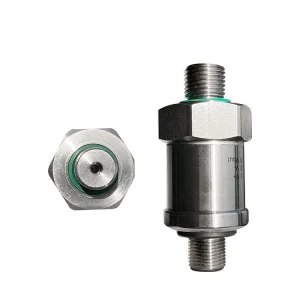
| Thin-Film Sensor Transducers | -40°C to +125°C | ±0.5% FS (High Precision) | Glass Microfused / Piezo-resistive | IP65 / IP68 Submersible | Hydraulic Circuits, HVAC Compressors |
| SF6 Gas Density Monitors | -40°C to +60°C | Class 1.0 (Temp Compensated) | Bimetal Linkage + Bourdon Tube | IP65 Hermetic Sealed Dial | High Voltage Gas-Insulated Switchgear |
The core physics of our bimetallic contact thermometers rely on bonding two metals with significantly different thermal expansion coefficients (e.g., Invar alloy and austenitic brass or stainless steel). When exposed to heat, differential expansion forces the bonded strip to bend into a helical coil.
Huzhou Accuracy Instrument utilizes proprietary continuous annealing heat treatments on all coils. This eliminates internal mechanical stress, preventing drift over time and guaranteeing linear angular deflection across the entire dial scale face.
For remote-reading contact applications, our liquid-filled capillary thermometers utilize low-viscosity silicone fluid or non-toxic organic compounds under high vacuum filling.
As temperature rises at the bulb sensor stem, fluid volume expands hydrostatic pressure, transmitting force through micro-bore armor-shielded capillary tubing (up to 10 meters) directly to a Bourdon mechanism inside the remote dial gauge. Laser-welded joints guarantee zero leakage even under cyclic pressure spikes.
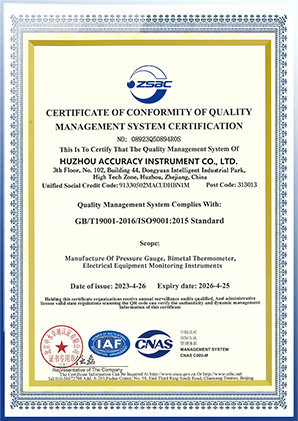
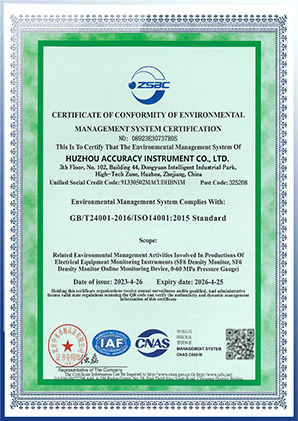
Operating in strictly regulated global markets requires absolute adherence to international metrology standards. Huzhou Accuracy Instrument maintains a rigid quality control system certified to ISO 9001:2008 and laboratory testing alignment with ISO/IEC 17025.
Every manufactured batch undergoes 100% over-temperature saturation testing and pressure fatigue cycling inside automated calibration chambers before pointer assembly.
Hermetically sealed stems, SF6 monitors, and capillary connections undergo high-sensitivity helium leak testing to guarantee zero medium leakage (< 1x10⁻⁸ mbar·l/s).
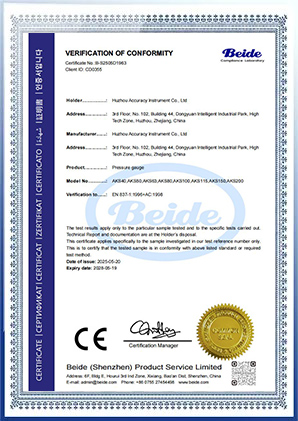
All electric contact instruments and pressure sensors comply fully with European CE directives (EMC & LVD) and environmental RoHS chemical safety parameters.
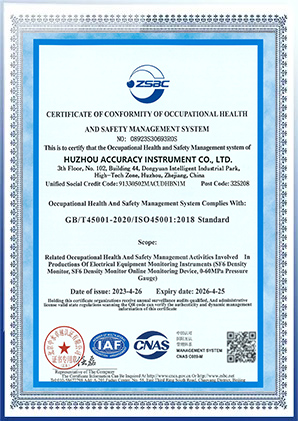
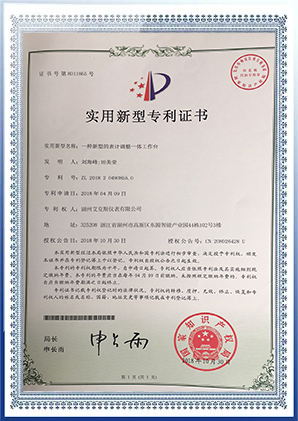
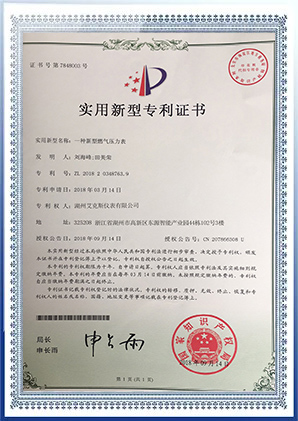
Our factory operates under long-standing management principles: "reasonable price, accurate delivery, uncompromising quality." Below are authentic snapshots of our international compliance and qualification certificates:
Every OEM deployment presents unique mechanical constraints, mounting orientations, and environmental stressors. Huzhou Accuracy Instrument engineers tailored solutions across global sites:
Challenge: Continuous high vibration (20-200 Hz) and rapid temperature cycling up to 550°C on engine manifolds.
Solution: Glycerin/Silicone liquid-filled every-angle bimetal thermometers with reinforced stem support, achieving a service life extension of 300%.
Challenge: Maintaining precise gas density measurements outdoors in extreme climate zones (-40°C winter to +50°C summer).
Solution: Temperature-compensated SF6 gas density monitors with gold-plated contact switches to trigger automatic emergency circuit breaker trips.
Challenge: Fluid contamination and space constraints in mobile construction equipment hydraulics.
Solution: Compact OEM AKS thin-film pressure transducers paired with integrated bimetallic probe switches for dual temperature/pressure telemetry.
The industrial Internet of Things (IIoT) requires traditional mechanical contact thermometers to evolve into hybrid digital-mechanical nodes. Our R&D department (comprising 20 dedicated specialists) is actively executing our 2025-2030 technology roadmap:
Integrating ultra-low power LoRaWAN and WirelessHART modules directly into standard 100mm dial cases. This allows local visual indication while broadcasting thermal data to cloud SCADA systems.
Pioneering glass-microfused silicon strain elements directly onto stainless steel diaphragms, yielding response times under 2 milliseconds with zero organic adhesive degradation.
Applying nano-scale PTFE, Tantalum, and Titanium Nitride (TiN) physical vapor deposition (PVD) to contact stems for extreme resistance against hot concentrated hydrofluoric and sulfuric acids.
Contact thermometers directly measure internal thermodynamic equilibrium without being influenced by surface emissivity variations, steam, dust, ambient light interference, or line-of-sight obstructions. They are robust, highly repeatable, require zero external electrical power (for mechanical models), and can operate safely inside pressurized fluid conduits via thermowells.
Choose a bimetallic thermometer when the reading dial can be mounted directly at the measurement point (stem lengths from 50mm to 1000mm) and when fast response time in direct fluid contact is required. Select a capillary thermometer when the measurement point is located in a dangerous, hot, or inaccessible area (e.g., inside a high-temperature oven or vibration-heavy engine block) and the readout dial must be mounted up to 10 meters away on a remote instrument control panel.
Electric switch contact thermometers feature adjustable magnetic snap-action or inductive contacts mounted on the pointer assembly. When the process temperature hits the user-preset threshold value, the mechanical arm physically closes (or opens) an electrical circuit, instantly sending a control signal to activate cooling fans, sound alarm horns, or initiate automated system shutdown sequence.
We provide end-to-end OEM customization: dial face branding, scale dual-units (°C/°F), stem length/diameter, process connection threads (NPT, BSP, BSPT, Metric, Tri-clamp), case materials (304/316 SS or black steel), liquid filling options (Glycerin, Silicone), and specific contact switch configurations (NO, NC, Double NO/NC).
Under standard industrial operating conditions, mechanical contact thermometers should undergo recalibration verification once every 12 months in accordance with ISO 9001 quality guidelines. In high-vibration or extreme high-temperature (>400°C) continuous service, semi-annual (6-month) bath calibration is recommended.
 Accuracy Instrument