Explore our top-tier precision instruments, engineered for heavy-duty industrial automation, energy processing, and process safety.
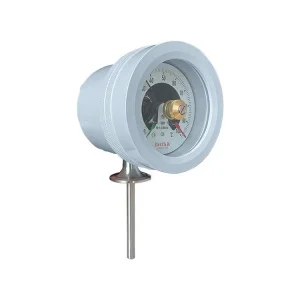
Understanding why direct-reading mechanical bimetal thermometers remain the cornerstone of process safety and operational resilience in modern industrial installations.
In an era driven by digital transformation and cloud-connected IoT sensors, the global industrial sector continues to rely on high-accuracy mechanical industrial bimetal thermometers as an indispensable primary line of defense. Valued at over $1.8 Billion globally within the industrial mechanical temperature indicator segment, bimetallic devices provide unpowered, intrinsically safe, continuous visual temperature monitoring across petrochemical refineries, thermal power generation units, pharmaceutical cleanrooms, and heavy marine engines.
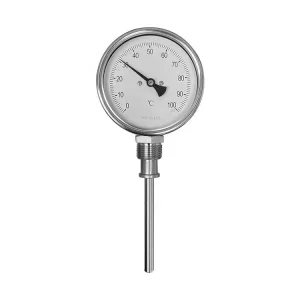
Unlike electronic sensors such as resistance temperature detectors (RTDs) or thermocouples—which require steady electrical power supplies, analog-to-digital signal converters, and complex cable shielding—a high-accuracy bimetal thermometer operates purely on fundamental physical metallurgy. By bonding two metals with distinct coefficients of thermal expansion (CTE), bimetallic elements convert thermal energy directly into mechanical angular displacement with high repeatability and zero susceptibility to electromagnetic interference (EMI), power surges, or software glitches.
Operates without external power or battery backup. Impervious to power outages, electrical noise, and high ambient electromagnetic field interference in heavy industrial zones.
Features precision-wound helical bimetallic strips engineered to optimize heat transfer efficiency while maintaining mechanical dampening for high-vibration equipment.
Encapsulated within AISI 304 or AISI 316L stainless steel enclosures, silicone-filled options absorb extreme mechanical shock and damp pointer flutter in harsh environments.
An engineering breakdown of thermal expansion dynamics, helical winding geometry, laser welding, and silicone dampening systems.
The core operating principle of Huzhou Accuracy Instrument's High Accuracy Industrial Bimetal Thermometers relies on differential thermal expansion. Two metallic strips of different thermal expansion coefficients are cold-welded together under high pressure. One alloy layer typically consists of an Invar iron-nickel alloy (low expansion coefficient, $\alpha \approx 1.2 \times 10^{-6}/\text{K}$), while the active layer utilizes a high-expansion alloy composed of nickel-manganese-iron or brass ($\alpha \approx 18-20 \times 10^{-6}/\text{K}$).
When exposed to temperature variations, the differential growth rate creates internal bending stress, forcing the bonded strip to curl. In industrial grade instruments, rather than using flat or spiral shapes, our engineering team utilizes continuous helical winding technology. The bimetallic element is formed into a fine helix inserted inside the stainless steel stem. One end of the helix is anchored firmly to the tip of the stem, while the floating axial end attaches directly to the pointer shaft.
The deflection angle ($\theta$) of the helical bimetal element is mathematically defined by: $\theta = \frac{K \cdot L \cdot \Delta T}{t}$, where K represents the flexivity constant of the specific alloy combination, L is the active helical length, t is total strip thickness, and $\Delta T$ is thermal variation. Precision manufacturing requires micro-level tolerance over t to prevent hysteresis.
| Performance Dimension | Standard Commercial Grade | China High-Accuracy Industrial Grade | Operational Impact & Value |
|---|---|---|---|
| Accuracy Class (EN 13190) | Class 1.5 or 2.0 (±1.5% to ±2.0%) | Class 1.0 (±1.0% Full Scale) | Eliminates measurement drift; ensures strict process control compliance. |
| Stem Metallurgy & Welding | Standard SS304 / TIG Welded | Hermetic Laser-Welded SS316L | Prevents micro-cracks and media fluid ingress under extreme thermal cycling. |
| Pointer Vibration Dampening | Dry / Air Dampened | High-Viscosity Silicone Oil Filled (1000 cSt) | Stabilizes needle indicator on heavy pumps, compressors, and diesel engines. |
| Dial Construction | Printed Paper / Aluminum Sheet | Anodized Anti-Parallax Aluminum Dial | Resists UV degradation, chemical fading, and reading errors from acute angles. |
| Zero Calibration Feature | Fixed / Non-adjustable Pointer | External Micro-Adjustable Reset Screw | Enables field re-calibration without dismantling or opening glass window seals. |
Tailored thermal indication solutions built to withstand corrosive media, extreme pressure, and high vibration environments across global key industries.
Deployed in distillation towers, crude lines, and cracking units. Standardized with thermowells, explosion-proof electric contacts (Ex d IIC T6), and SS316L wetted parts to resist $H_2S$ corrosion.
Monitors steam turbine bearings, generator cooling systems, and transformer oil temperatures. Silicone-filled dials prevent pointer degradation from high continuous operational vibrations.
Sanitary bimetal thermometers equipped with Tri-Clamp sanitary connections, mirror-polished stem finishes (Ra < 0.4 µm), and inert non-toxic silicone fill liquids per FDA requirements.
Measures engine exhaust temperatures up to 600°C, boiler feed temperatures, and chilled water loops with customized stem lengths and adjustable angle mounting for versatile installation.
Established over two decades ago, Huzhou Accuracy Instrument Co., Ltd. operates a modern 3,000 square meter manufacturing facility specialized in high-performance pressure and temperature measurement instruments. Combining advanced production lines with laser calibration and high-vacuum oil filling systems, we serve leading industrial clients in over 30 countries worldwide.
Our operational capabilities include an annual output exceeding 2 million units across industrial mechanical pressure gauges, bi-metal thermometers, SF6 gas density monitors, and microfused pressure sensors. Engineered strictly under ISO 9001 and ISO 17025 certified quality management systems, our products offer high corrosion resistance, anti-vibration performance, and long-term zero-leak reliability under extreme conditions.
ISO 9001:2008 & CE Certified Facility
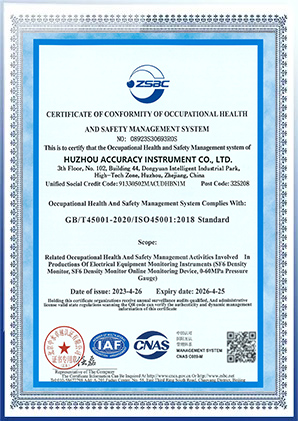
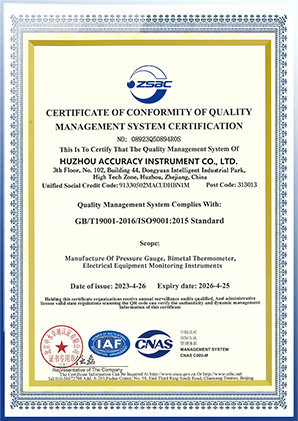
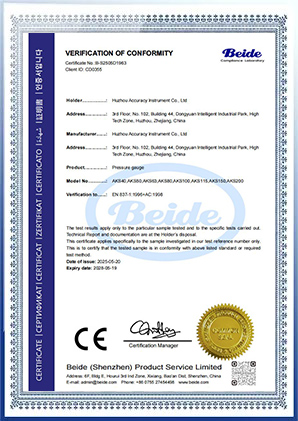
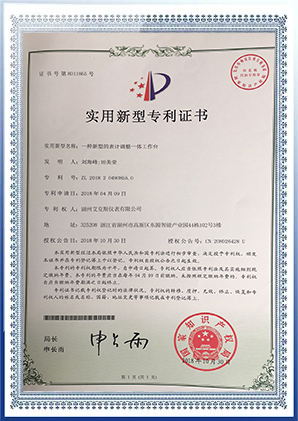
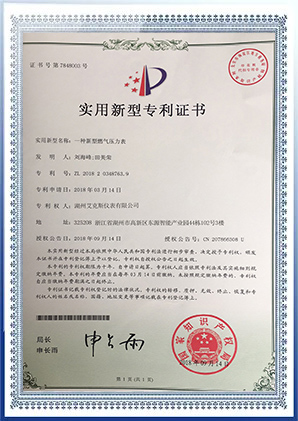
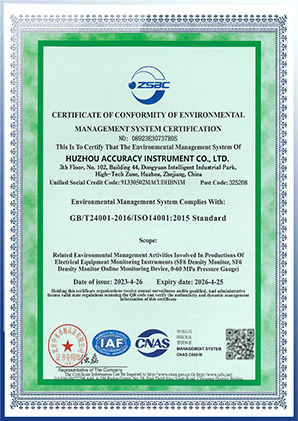
Every thermometer undergoes multi-point fluid thermal bath calibration and pressure seal testing before dispatch.
Manufactured strictly in accordance with European standard EN 13190 and American standard ASME B40.200 for dial-type bimetallic thermometers, ensuring global interchangeable installation compliance.
Every thermometer undergoes 100% 3-point calibration testing in computer-controlled thermostatic liquid calibration baths (0%, 50%, and 100% full scale) to guarantee Class 1.0 performance.
Subjected to accelerated life testing, including sinusoidal vibration resistance testing (10 Hz to 150 Hz, 2g acceleration) and IP67 dust/water immersion validation for harsh outdoor plants.
Merging robust mechanical temperature indicators with digital IoT intelligence for Industry 4.0 applications.
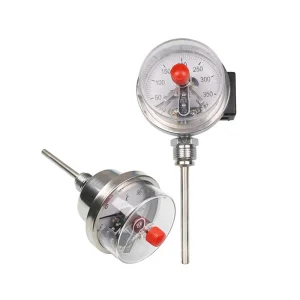
Integrating fail-safe non-contact magnetic and inductive switch contacts into standard dials to trigger automated emergency relief valves without mechanical drag.
Developing ultra-low-power optical dial encoders that mount directly onto existing bimetal faces, transmitting real-time temperature telemetry wirelessly to SCADA systems.
Advanced physical vapor deposition (PVD) and PTFE sleeve encapsulation for stems operating in extreme marine, hydrofluoric acid, and chlorine environments.
Answers to critical technical queries regarding bimetal thermometer selection, installation, thermowells, and calibration.
According to EN 13190 standards, Class 1.0 accuracy means the maximum permissible error (MPE) of the thermometer is within ±1.0% of its full scale span (e.g., ±2.0°C for a 0°C to 200°C range). Class 1.5 allows an error of up to ±1.5% of full scale. High accuracy industrial processes, such as chemical reactor vessels and custody transfer heat monitoring, mandate Class 1.0 to ensure tight quality control and safety compliance.
A thermowell must be used whenever the sensor stem is exposed to pressurized fluids (typically exceeding 16 bar), high-velocity media, corrosive liquids, or applications requiring thermometer removal without shutting down line pressure. Thermowells protect the delicate bimetallic stem from mechanical shear stress, erosion, and high hydraulic pressures while enabling rapid unit replacement.
Vibration from industrial equipment like compressors, diesel engines, and heavy pumps causes mechanical flutter in dry pointers, leading to rapid wear of movement gears and difficult manual reading. Filling the dial case with high-viscosity silicone fluid dampens internal pointer oscillation, lubricates mechanical gear pivots, prevents window fogging from ambient humidity, and significantly extends operational lifespan.
To achieve rated accuracy, the active helical element inside the stem must be completely submerged in the target fluid zone. As a general engineering rule, the minimum stem insertion length should equal at least 8 to 10 times the stem outer diameter (for example, at least 50 mm for a standard 6.35 mm diameter stem) plus the internal helical length. Insufficient insertion results in ambient thermal conduction errors along the stem wall.
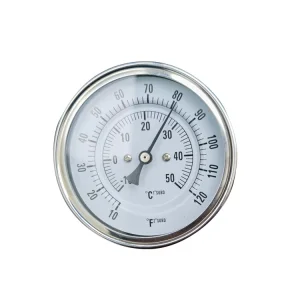
Huzhou Accuracy industrial bimetal thermometers feature an external calibration adjustment screw located on the back or side of the case. By turning this screw using a hex key or screwdriver, the internal anchor position of the bimetal coil is rotated relative to the dial face. This allows field engineers to perform zero-point adjustments or field re-calibration without opening the sealed glass bezel or breaking the IP67 case seal.
Discover our extended line of specialized mechanical gauges, electric contact switches, and OEM bi-metal solutions.
 Accuracy Instrument