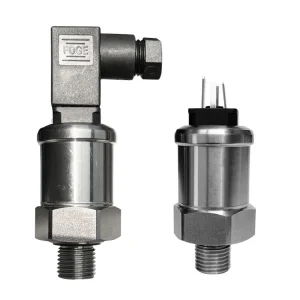
Explore our CE-certified industrial pressure gauges, SF6 density monitors, temperature indicators, and sensor transmitters engineered for extreme environments.
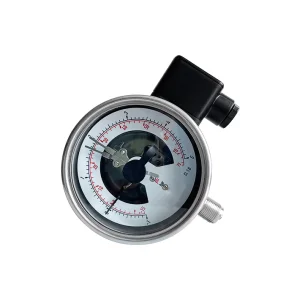
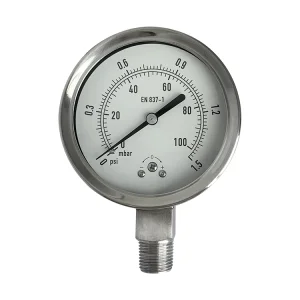
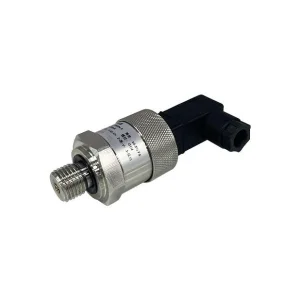
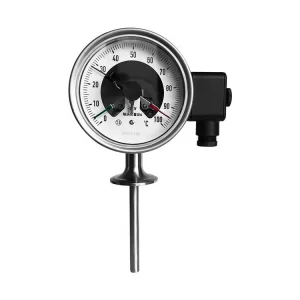
In global industrial process control, fluid dynamics, and pneumatic automation, fluid measurement metrics are fundamentally split into distinct reference frameworks. Procurement officers and instrument engineers seeking insights under the query term "What is Gauge Pressure" require absolute mathematical clarity to select the correct mechanical manometer, electronic transducer, or bi-metal sensor for severe processing environments.
Gauge pressure is the pressure relative to the local ambient atmospheric pressure ($P_{atm}$). When a pressure gauge reads zero under ambient laboratory conditions, it indicates that internal system pressure equals ambient barometric pressure. The mathematical relationship is expressed as:
$P_g = P_{abs} - P_{atm}$
Where $P_{abs}$ represents absolute pressure. A positive gauge reading indicates system pressurization above atmospheric level, whereas a negative reading signifies partial vacuum conditions.
Unlike absolute pressure—which measures force per unit area relative to a perfect, zero-molecule vacuum ($0 \text{ bar a}$)—gauge pressure changes dynamically with altitude, temperature fluctuations, and barometric weather shifts. Absolute pressure is critical for hermetic gas calculation (e.g., ideal gas law $PV=nRT$), whereas gauge pressure is essential for structural vessel safety and pipe burst stress management.
Differential pressure measures the direct numerical difference between two discrete pressure ports ($P_1 - P_2$). It forms the backbone of orifice plate flowmeters, filter clogging indicators, and cleanroom air balance systems. High-end Chinese manufacturers integrate diaphragm-based differential sensing into specialized switchgear and HVAC monitoring systems.
Because mechanical gauge pressure relies on ambient pressure as its baseline baseline ($0 \text{ bar g}$), high-altitude installations require recalibration or custom absolute sensor conversions to ensure process accuracy.
| Altitude Above Sea Level (Meters / Feet) | Ambient Atmospheric Pressure ($P_{atm}$) | Barometric Shift (kPa / PSI) | Gauge Calibration Adjustment Needed |
|---|---|---|---|
| 0 m / 0 ft (Sea Level) | 101.325 kPa / 14.696 PSI / 1.013 bar | Baseline Standard (0.00) | Standard Factory Calibration ($\pm 0.5\%$ FS) |
| 500 m / 1,640 ft | 95.46 kPa / 13.845 PSI / 0.954 bar | -5.86 kPa / -0.85 PSI | Minor Zero-Point Tare Correction Required |
| 1,000 m / 3,280 ft | 89.87 kPa / 13.034 PSI / 0.898 bar | -11.45 kPa / -1.66 PSI | Recommended Factory Altitude Set-Point adjustment |
| 2,000 m / 6,560 ft | 79.49 kPa / 11.529 PSI / 0.794 bar | -21.83 kPa / -3.17 PSI | Mandatory Factory Sealed Chamber Recalibration |
| 3,000 m / 9,840 ft | 70.10 kPa / 10.167 PSI / 0.701 bar | -31.22 kPa / -4.53 PSI | Use Hermetically Sealed Transducer / Absolute Sensor |
Over the past two decades, China’s industrial instrumentation landscape has evolved from simple assembly facilities into fully integrated R&D centers capable of micrometer-level machining, advanced laser welding, and automated pressure standard calibration. Western EPC contractors, OEM equipment builders, and global distributors leverage Chinese gauge manufacturers to achieve superior cost efficiency without compromising compliance with ISO 9001, CE, and ASME B40.100 standards.
Manufacturing clusters in Zhejiang (such as Huzhou) provide immediate access to high-grade raw materials: SS304, SS316L, Hastelloy C-276, Monel, and specialized Phosphor Bronze Bourdon tubing. This localized supply chain eliminates sourcing delays and guarantees high material traceability.
Leading Chinese factories utilize automated pneumatic and hydraulic pressure calibrators equipped with optical laser pointers. Every dial index, movement pinion, and pointer gear is micro-matched to guarantee repeatable accuracy classes ($\pm 1.0\%$, $\pm 1.6\%$, up to $\pm 0.5\%$ full scale).
Industrial gauge suppliers perform 100% pressure cycle fatigue tests, helium leak checks, high-temperature fluid media simulations, and IP65/IP67 ingress testing to ensure zero-leak reliability under heavy thermal shock and pulsation.
Huzhou Accuracy Instrument Co., Ltd. brings over two decades of technical expertise and research to global industrial mechanical pressure gauges, bimetal thermometers, SF6 manometers, and electronic pressure sensors. Our 3,000 square meter facility features automated assembly lines and specialized testing laboratories.
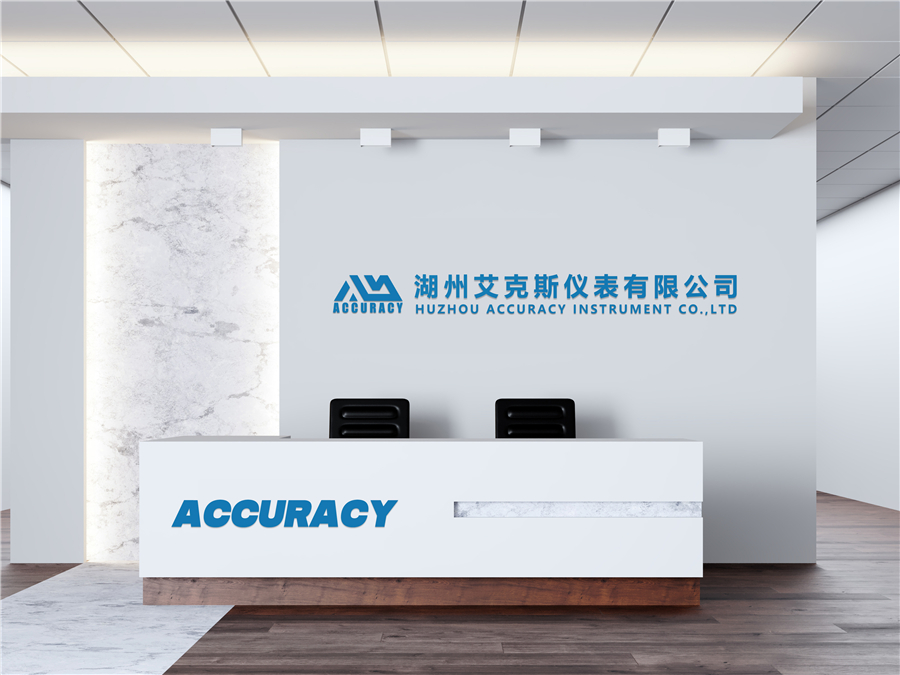
Dedicated to material innovation, smart IoT sensor integration, thin-film piezoresistive diaphragms, and compliance with ISO, API, and CE safety standards.
Utilizes automated laser-welding systems, computerized gear-mesh assembly, and high-precision calibration to ensure continuous durability.
Provides 24/7 technical support, fluid compatibility engineering, custom dial layout design, and rapid export logistics management.
Pressure gauges serve diverse functions across critical infrastructure. Selecting the proper gauge structure (e.g., Bourdon tube, diaphragm seal, piezoresistive ceramic cell) is key to operational safety, system longevity, and regulatory compliance.
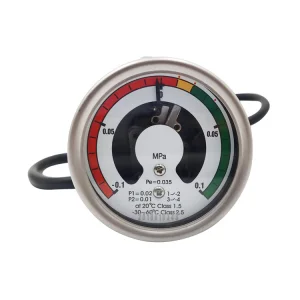
Sulfur Hexafluoride ($SF_6$) gas insulates high-voltage electrical breakers. Temperature-compensated $SF_6$ gas density monitors maintain constant gas pressure verification (-0.1 to 0.1 MPa) despite severe ambient weather shifts, preventing flashover risks in electrical substations.
Corrosive media such as sour gas ($H_2S$), crude oil, and heavy hydrocarbons require 316L stainless steel or NACE MR0175 compliant wetted parts. Liquid-filled (glycerin/silicone oil) vibration-resistant gauges absorb mechanical shock in pump skid discharge lines.
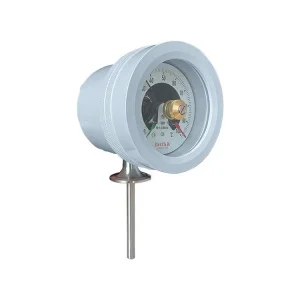
Sanitary applications demand zero-dead-space diaphragm seal pressure transmitters. Featuring 3-A compliant surface polishing ($Ra < 0.4 \mu m$) and hygienic Tri-Clamp connections, these units withstand CIP/SIP steam sterilization cycles.
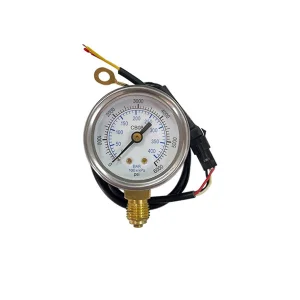
Automotive Compressed Natural Gas systems require compact, explosion-proof pressure sensors (5V/12V DC input) with high burst pressure ratios (up to 400 bar). These gauges provide real-time dashboard telemetry and fuel-injection safety cutoffs.
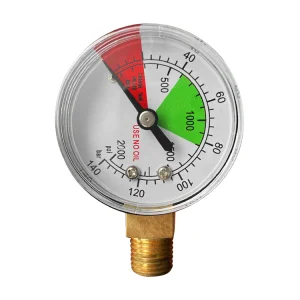
High-efficiency chillers using eco-refrigerants (R410A, R32, $CO_2$) demand dual-scale pressure/temperature gauges. Stainless steel movement mechanisms ensure minimal creep over millions of thermal expansion cycles.
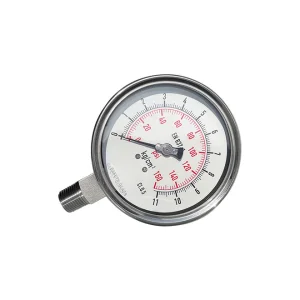
Hydraulic power units experience intense pressure spikes. Stainless steel shock-proof pressure gauges feature heavy-duty restrictive screws and dampening fluid to prevent pointer flutter during high-frequency valve actuation.
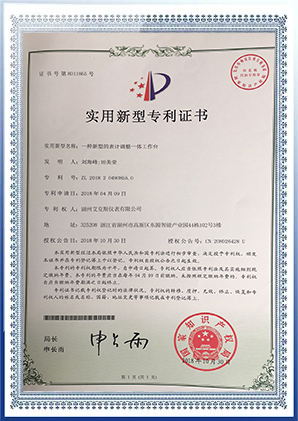
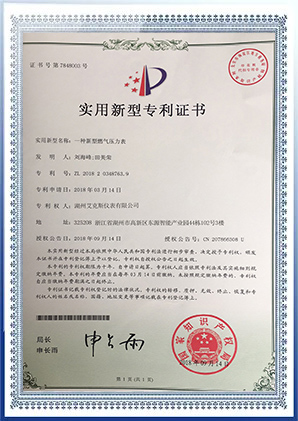
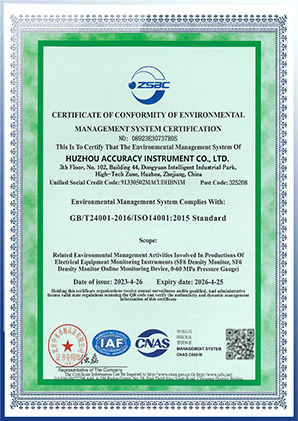
Huzhou Accuracy Instrument Co., Ltd. operates under strict ISO 9001:2008 quality management guidelines and ISO 17025 laboratory standards. Every product line carries international safety certifications, including CE compliance for European export markets.
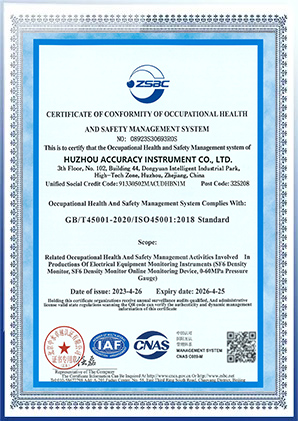
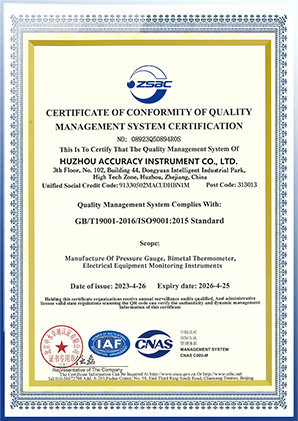
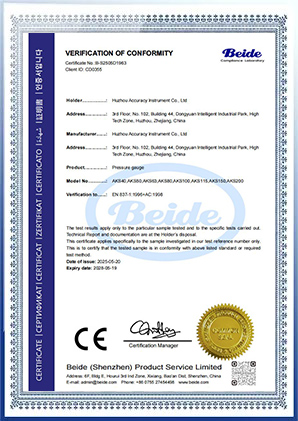
Selecting the ideal gauge pressure instrument requires matching chemical properties, dynamic mechanical loads, thermal limits, and electrical signal needs. Misspecifying these options can cause gauge drift, diaphragm failure, or localized leaks.
| Parameter / Specification | Industrial Standard Options | Engineering Selection Criteria |
|---|---|---|
| Dial Nominal Diameter | 40mm (1.5"), 50mm (2"), 63mm (2.5"), 100mm (4"), 150mm (6") | Select larger dials (100mm/150mm) for distant visual reading; smaller dials for compact OEM control panels. |
| Case Material & Design | Black Painted Steel, AISI 304 Stainless Steel, AISI 316 Stainless Steel, Cast Aluminum | Use 316 Stainless Steel for offshore marine, corrosive chemical plants, and outdoor IP67 environments. |
| Accuracy Class (EN 837-1) | Class 2.5 ($\pm 2.5\%$), Class 1.6 ($\pm 1.6\%$), Class 1.0 ($\pm 1.0\%$), Class 0.5 ($\pm 0.5\%$) | Process plant standards usually require Class 1.0 or 1.6; master test gauges require Class 0.5 or 0.25. |
| Process Connection Threads | 1/8", 1/4", 3/8", 1/2" (NPT, BSP/G, Metric M20x1.5) | NPT threads self-seal via thread interference; BSPP (G) uses flat gaskets; BSPT uses thread sealant. |
| Wetted Parts Material | Brass / Copper Alloy, SS 316L, Ceramic ($Al_2O_3$), Hastelloy C-276, Tantalum Diaphragm | Copper alloys are suitable for air/water; use SS 316L or Ceramic for acidic/corrosive fluids. |
| Liquid Filling Option | Dry non-filled, Glycerin (99.5%), Silicone Oil (High/Low Temp) | Glycerin dampens severe machine vibration; Silicone oil is required for extreme temperatures (-40°C to +100°C). |
| Electrical Signal Output | Dry Contact Switches, 4-20mA 2-Wire, 0-10V DC, RS485 Modbus RTU | Select 4-20mA loops for long-distance signal integrity; dry contacts for automated pump safety shutdown switches. |
Answers to common technical, calibration, and procurement questions compiled by senior instrumentation engineers at Huzhou Accuracy Instrument Co., Ltd.
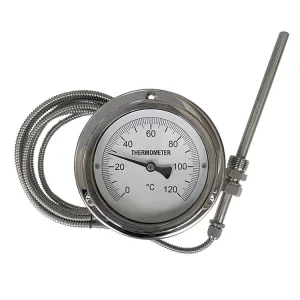
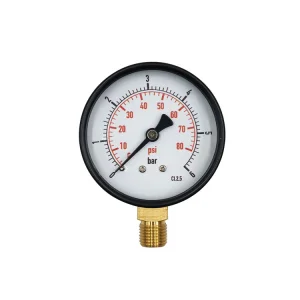
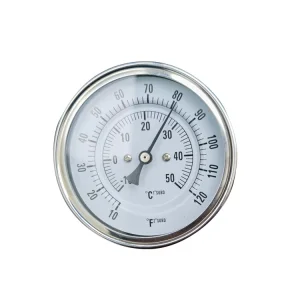
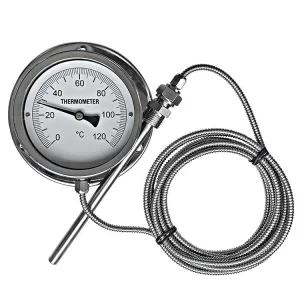
Complete factory-direct product catalog featuring high-precision capillary thermometers, CNG transducers, ceramic sensors, and air manometers.
 Accuracy Instrument